Invisalign vs. Braces: What Science and 20 Years of Practice Tell Us
A clear-eyed guide to choosing the right treatment for your smile
One of the most common questions I hear in my consultation room overlooking Lake Zurich is: "Doctor, which is better — Invisalign or braces?" It is a question I genuinely enjoy, because the honest answer reveals a lot about how modern orthodontics actually works.
Two Technologies, One Goal
Fixed braces — whether metal or ceramic — use brackets bonded to the teeth and a wire that runs through them. The wire applies continuous force, gradually guiding teeth into their ideal position. The system is highly predictable, works around the clock, and requires no patient compliance beyond wearing them.
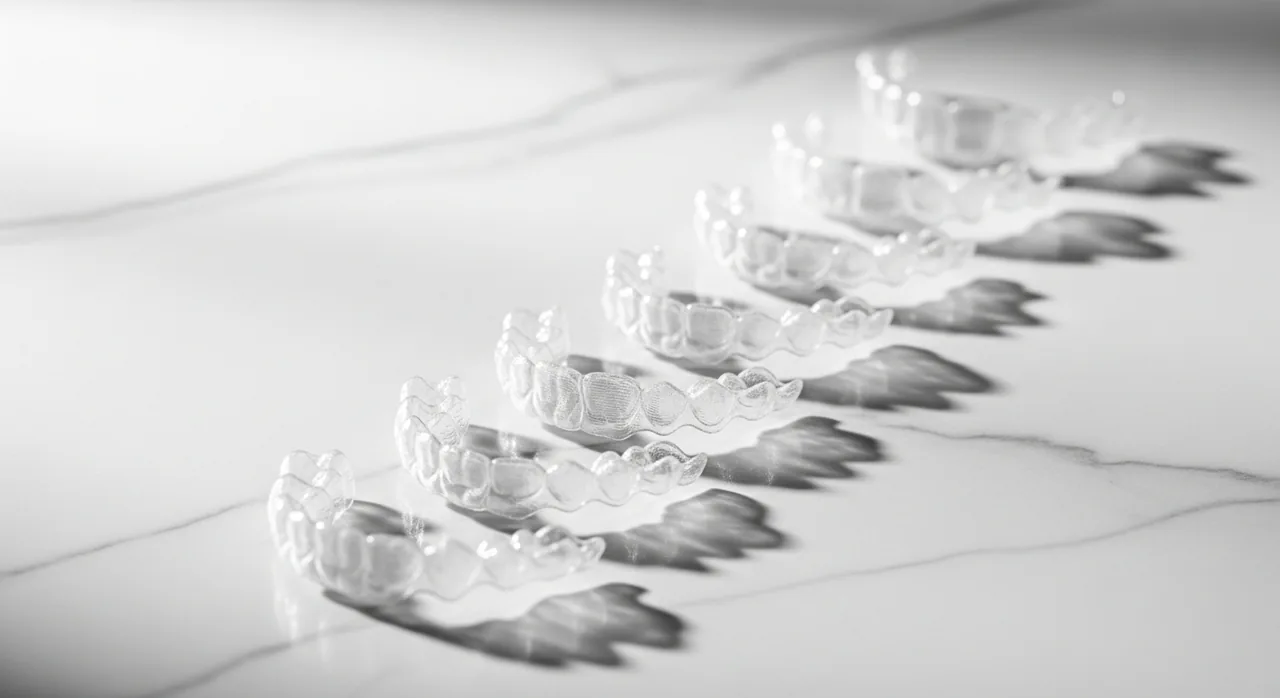
Invisalign uses a series of custom-made, removable clear aligners. Each set is worn for approximately one to two weeks, moving teeth in small, precise increments. The aligners are virtually invisible and can be removed for meals and oral hygiene — making them popular with adults and professionals.
"The question is never which treatment is "better" in absolute terms. It is which treatment is better for this patient, this case, and this lifestyle."
— Dr. Alexander Dudic, MAS, PhD
What the Research Shows
My academic work at the Universities of Geneva and Gothenburg has focused on the mechanics of tooth movement — specifically, how much force, applied for how long, produces effective movement with minimal side effects such as root resorption. This research informs my daily clinical decisions.
The clinical literature consistently shows that both systems achieve excellent outcomes for most malocclusions when applied correctly by a specialist. The key word is 'specialist'. Results from a certified orthodontist using either system significantly outperform results from general dentists or dentists with a simple master in orthodontics using the same technology.
When Invisalign Has the Edge
- Mild to moderate crowding and spacing issues
- Adult patients who prioritize aesthetics during treatment
- Patients with high-contact sports or playing wind instruments
- Cases where precise treatment planning benefits from 3D digital simulation
- Patients who travel frequently and cannot attend regular adjustments
When Fixed Braces Perform Better
- Severe crowding, rotations, or complex bite corrections
- Growing patients (children and teenagers) with developing arches
- Cases requiring precise control of tooth torque and root movement
- Patients who may struggle with compliance — braces work regardless
- Cases combined with orthognathic surgery
The Lakeside Approach: Choosing Together
At Lakeside Kieferortho, every new patient receives a comprehensive digital examination — including intraoral scans, digital X-rays, and 3D facial analysis. This data allows me to model your treatment outcome before a single appliance is fitted.
I present both options whenever both are clinically appropriate, showing you simulated outcomes for each. My role is to give you the information you need to make a decision aligned with your life, your aesthetic preferences, and your budget — not to sell you a particular product.
As a certified Invisalign Platinum Provider and a specialist in fixed appliance techniques including lingual braces, I have no bias toward either system. My only commitment is to your result.

Dr. Alexander Dudic
MAS, PhD · Specialist Orthodontist
Orthodontist and founder of Lakeside Kieferortho in Wädenswil.