How Long Does Orthodontic Treatment Really Take?
The science of tooth movement — and what it means for your timeline
During my doctoral research at the University of Göteborg, I spent years studying the mechanics of orthodontic tooth movement — specifically, what determines how fast teeth move and how we can optimise that speed without compromising root integrity. What I discovered is that the popular "12 to 24 months" answer is, at best, a starting point.
The Biology of Tooth Movement
Teeth do not move because we force them. They move because orthodontic pressure triggers a biological remodelling process in the bone surrounding the tooth roots. On the pressure side, bone is resorbed; on the tension side, new bone is deposited. The tooth migrates through this controlled process.
This means that tooth movement is, fundamentally, a biological process with biological limits. You cannot simply apply more force to move teeth faster without causing damage to roots, gums, and supporting bone. My published research has documented the relationship between the amount of movement and root resorption — one reason I am very precise about force levels in my practice.
"There is an optimal force window for tooth movement — below it, teeth don't move efficiently; above it, you risk irreversible root damage. Our job is to stay precisely within that window, for the entire duration of treatment."
— Dr. Alexander Dudic, MAS, PhD
Factors That Affect Your Treatment Duration
- Severity of misalignment — mild crowding can resolve in 8–12 months; complex bite corrections may take 24–30 months
- Patient age — in younger patients (teenagers), the bone remodelling process starts faster than in adults
- Treatment type — some techniques offer better control for complex movements
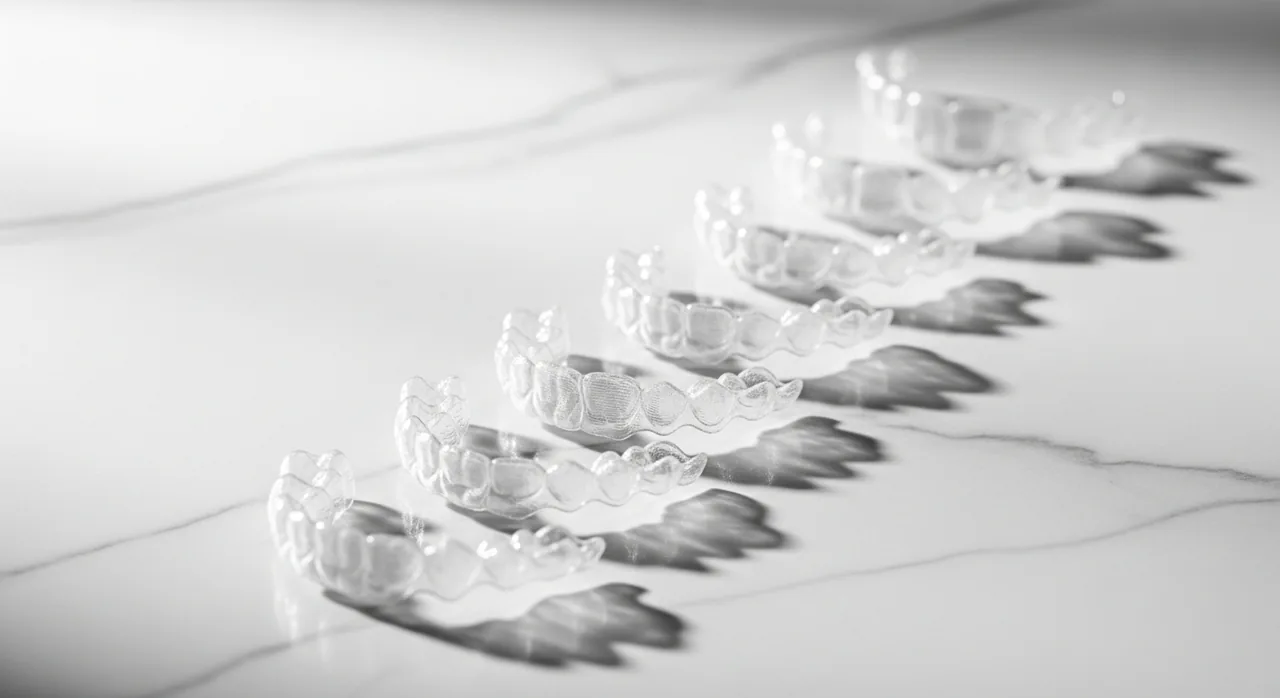
- Compliance — with removable aligners, wearing them 20–22 hours per day is non-negotiable
- Appointment adherence — missing adjustments delays progress directly
- Individual biology — some patients simply move teeth faster than others
How Digital Technology Has Changed the Equation
At Lakeside Kieferortho, we use digital 3D scanning and AI-assisted treatment planning to map your entire treatment arc before we begin. This allows us to identify potential obstacles early, choose the optimal force mechanics, and give you a genuinely personalised timeline — not a generic estimate.
For aligner patients, our digital monitoring technology also allows certain cases to progress with fewer in-person appointments, without sacrificing precision. For patients commuting from Zurich, Horgen, or Thalwil, this is a meaningful practical benefit.
Do Not Forget the Retention Phase
Orthodontic treatment does not end when the braces come off or the last aligner is worn. The retention phase — during which you wear a fixed or removable retainer — is arguably the most important phase of treatment. Teeth have a natural tendency to drift back toward their original position, driven by the same biological forces that moved them. A well-designed retention protocol protects your investment indefinitely.
At Lakeside, we discuss retention from the very first consultation, so you know exactly what to expect — not just during treatment, but for the years that follow.

Dr. Alexander Dudic
MAS, PhD · Specialist Orthodontist
Orthodontist and founder of Lakeside Kieferortho in Wädenswil.